Commercial painting timeline, after-hours scheduling, COI paperwork, and how property managers coordinate the work.
Managing a property update in Northern New Jersey often feels like juggling glass. You want a fresh look, but shutting down daily operations is rarely an option.
Knowing exactly what to expect during a commercial painting project separates a smooth upgrade from a tenant nightmare.
We have found that clear timelines and strict protocols keep everyone happy. Let’s look at the data, the specific local regulations, and the exact process you need to follow.
Typical Commercial Project Sequence: Commercial Painting Project What to Expect
A standard commercial painting timeline moves systematically from an initial walkthrough to the final invoice. This structured approach prevents expensive delays and ensures compliance with local building codes.
We typically start with a thorough site evaluation to check access rules and scope out the surface conditions. Older properties require special attention, especially anything built before 1978.
The Environmental Protection Agency (EPA) enforces strict Renovation, Repair, and Painting (RRP) rules for these older structures. Skipping this lead-safe certification can trigger fines of up to $37,500 per day.
Our process guarantees that every base is covered before a single drop of paint is applied.
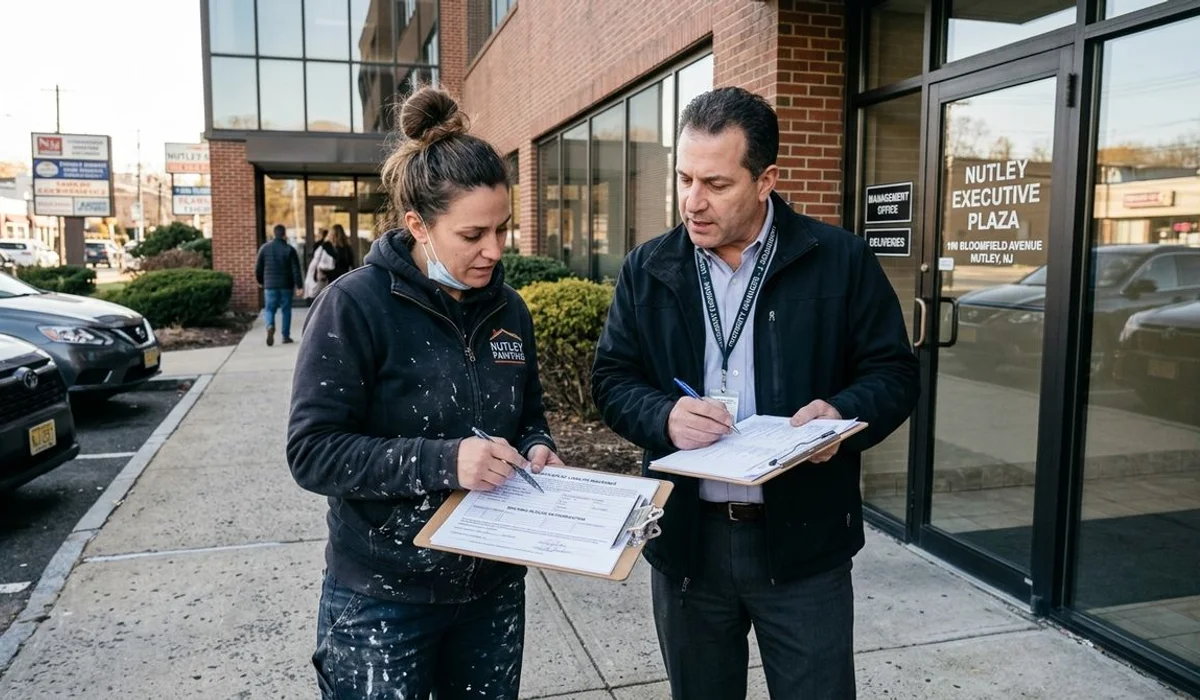
- Assessment and Proposal: We assess the scope, check for EPA RRP requirements, and deliver written proposals with Certificates of Insurance.
- Scheduling Coordination: We align calendars with the business owner, property manager, or building manager.
- Pre-Job Meeting: Access codes, alarm coordination, and building-specific rules are finalized.
- Work Execution: Crews operate after-hours, on weekends, or during occupied business hours.
- Daily Walkthrough: An end-of-shift review guarantees spaces are instantly ready for business.
- Final Walkthrough: Final sign-off and invoicing follow standard accounts payable requirements.
After-Hours Execution
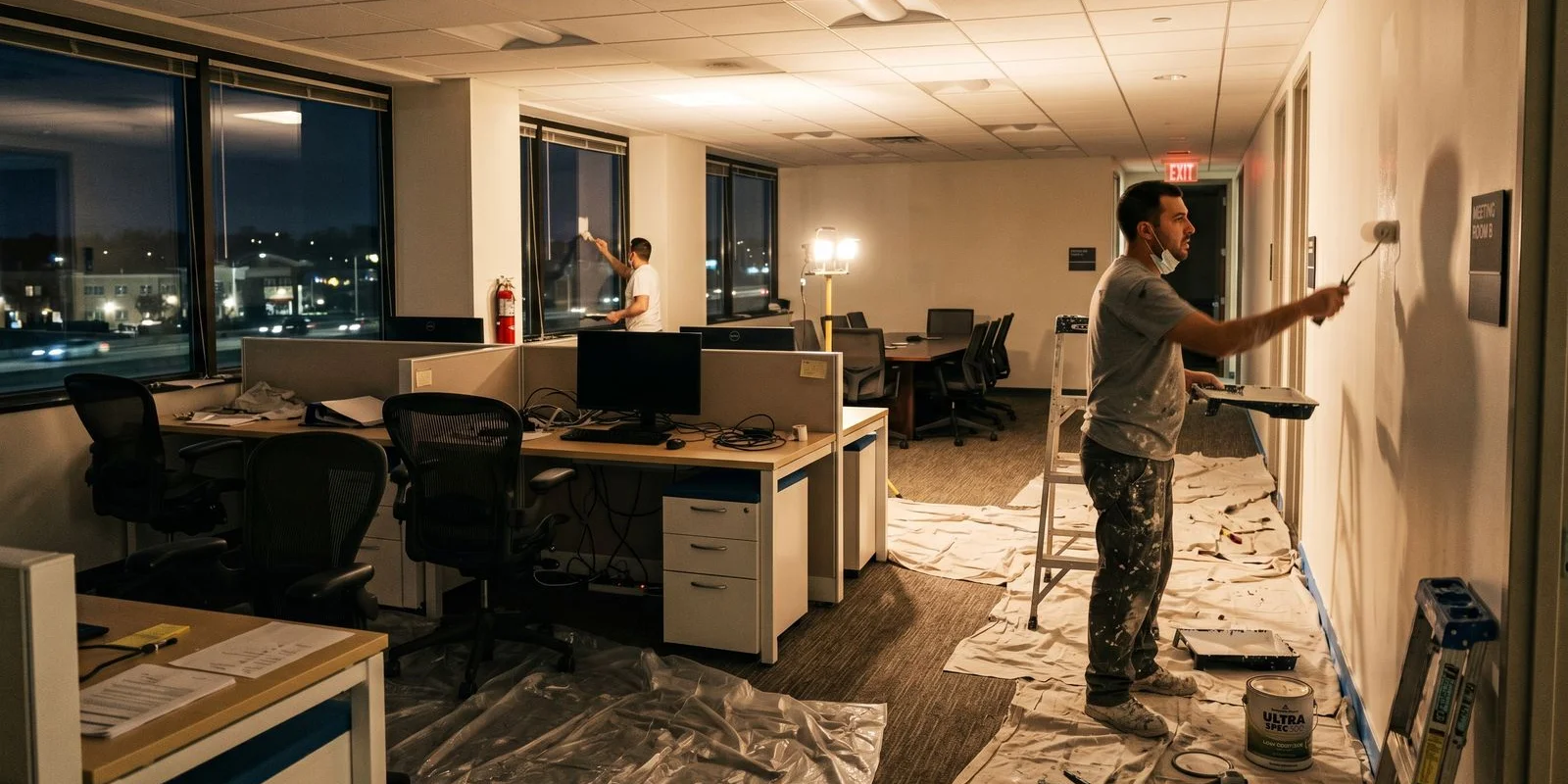
The after-hours office painting process requires strict adherence to local noise rules and security protocols. Night shifts allow for maximum productivity without disrupting your tenants.
We always arrive 30 minutes before the designated work window begins. This buffer gives the team time to review the safety checklist.
New Jersey municipalities strictly enforce noise ordinances between 10:00 PM and 7:00 AM. Heavy machinery or loud compressors must stay below the 50-decibel limit near residential interfaces.
Our night crews rely on quiet, efficient tools to stay compliant while masking areas and laying down drop cloths. Product selection is also critical for evening work.
We utilize fast-drying commercial coatings like Sherwin-Williams Pro Industrial to ensure surfaces are fully cured by morning. This eliminates the risk of tacky walls when employees arrive the next day.
- Night Shift Protocol:
- Arrive early to coordinate entry with security staff.
- Set up drop cloths, masking tape, and low-noise tools.
- Execute the agreed scope while adhering to decibel limits.
- Clean the entire area completely before business hours begin.
- Leave the workspace in an immediately usable state.
Occupied Space Work
Sometimes a property manager painter must work during normal business hours. This requires surgical precision to protect air quality and keep walking paths clear.
We contain the work area using heavy-duty plastic barriers and drop cloths. Keeping dust and fumes out of occupied zones is the top priority.
Benjamin Moore recently introduced Eco Spec, replacing their Natura line as their premier zero-VOC option. This asthma and allergy-friendly formula has virtually no smell, and any faint odor dissipates within 60 minutes.
Our team uses this product alongside high-efficiency HEPA air scrubbers to maintain pristine indoor air quality. Coordinating the schedule ensures the least amount of friction for your staff.
Paint application in conference rooms, for instance, should always happen on meeting-light days.
- Best Practices for Occupied Areas:
- Zero-VOC Paint: Utilize Benjamin Moore Eco Spec or Sherwin-Williams Harmony.
- Airflow Management: Deploy plastic barriers and HEPA filtration systems.
- Strategic Scheduling: Target high-traffic zones during predictable lulls.
- Safety Corridors: Maintain clear, hazard-free walking paths at all times.
- Proactive Communication: Send staff notifications via the property manager.
Paperwork Standards
Comprehensive documentation protects your property from liability and ensures accountability. Every professional contractor must supply verified paperwork before stepping onto your site.
We generate a detailed, itemized proposal that clearly defines the scope, schedule, and exact price. A verbal agreement is never enough in the commercial space.
The industry standard for verifying coverage is the ACORD 25 Certificate of Liability Insurance. While the New Jersey Division of Consumer Affairs (NJ DCA) requires a minimum of $500,000 for basic Home Improvement Contractors, commercial projects demand higher protection.
Our policies carry a standard $1,000,000 per occurrence and a $2,000,000 aggregate limit to shield building owners completely. A comprehensive paperwork package should include several mandatory elements.
Required Documentation Checklist
- ACORD 25 COI: Verifies general liability, workers’ compensation, and property damage coverage.
- Additional Insured Status: The building owner and management company must be named directly on the certificate.
- State Registration: A valid NJ HIC registration number must appear on every proposal.
- Written Contract: All project phases, deadlines, and pricing must be legally bound in writing.
- Warranty Terms: A one-year workmanship warranty is the baseline standard for commercial jobs.
Communication Flow
A streamlined communication flow eliminates confusion and keeps the project moving smoothly. Too many voices can easily derail a tight schedule.
We establish a single point of contact on both sides of the agreement right from the start. The primary contact on the contracting side will always be the owner or a dedicated project lead like L. Smith.
The client side should designate the business owner or the property manager as the sole decision-maker. Our field teams utilize modern construction management apps like BuilderTrend or simple Slack channels to share real-time updates.
This centralized approach prevents crossed wires and missed text messages. You will receive a daily progress report outlining what was finished and what happens next.
- Daily Updates: Expect consistent text or email logs during active work phases.
- Visual Proof: Photos of completed areas are shared before the morning shift arrives.
- Issue Resolution: A single point of contact ensures quick answers to any unexpected challenges.
- Final Verification: An end-of-project walkthrough happens with both parties to confirm complete satisfaction.
Invoicing
Commercial invoicing structures rely on clear terms and predictable payment windows. Net-15 or Net-30 payment terms are the established standard across Northern New Jersey.
We supply a completed W-9 upfront so your accounting department can process payments without delay. Modern projects often utilize automated platforms like Bill.com to simplify this exact process.
For standard capital improvements, a simple, flat-fee invoice is usually sufficient. Our accounting team provides per-unit itemization when handling large-scale tenant turnovers, making cost tracking effortless for property managers.
Secure online payments via ACH are highly preferred, though traditional checks remain widely accepted. Some larger commercial renovations may even utilize standard AIA billing forms to track progress payments accurately.
| Payment Method | Processing Speed | Best Used For |
|---|---|---|
| ACH Bank Transfer | 1-2 Business Days | Standard Net-30 invoices (Preferred) |
| Physical Check | 5-7 Business Days | Traditional corporate accounts payable |
| AIA Billing (G702/G703) | Variable | Large-scale, multi-month renovations |
Explore our commercial painting service pages to see recent examples of this workflow in action. You can also review our detailed commercial painting cost breakdown to help plan your upcoming budget.
If you are ready to improve your facility, reaching out for a detailed consultation is your smartest next step.
We know that every commercial painting project what to expect guide can only cover the basics.
Your specific building will have unique challenges. Give us a call to get a customized, data-driven plan in motion today.